


The Roman naturalist Pliny the Elder considered opal to be the purest and noblest of all gems. He was fascinated by its changing beauty, which unites in a single stone the fiery shine of ruby, the purple shine of amethyst and the sea green of emerald.
In ancient times it was called "the ancestor of all gemstones".
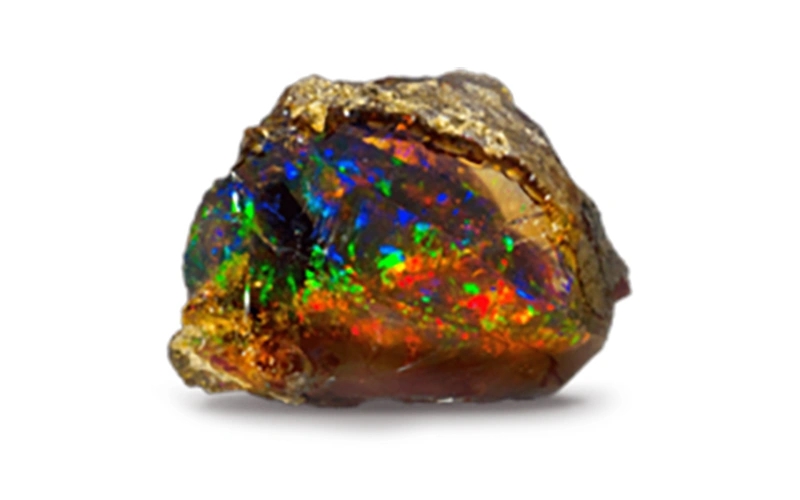
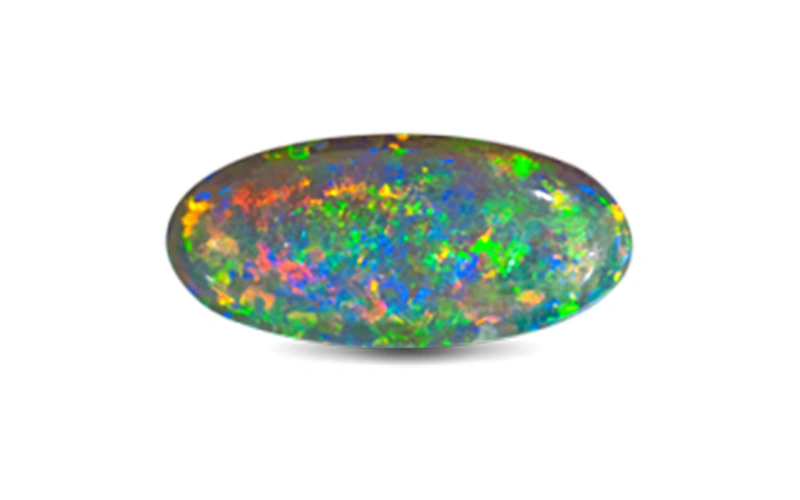


GEM INFORMATION
FEATURES
| MINERAL | amorphous form of quartz and water |
| CHEMICAL COMPOSITION | SiO2.nH2O |
| COLOR | Gray/ Black/ Green/ reflection colors - white, yellow, orange, rose-red, black, blue |
| REFRACTION INDEX | 1.37- 1.43 |
| BIREFRINGENCE | none |
| HARDNESS ACCORDING TO THE MOHS CHART | 5,5- 6,5 |
| SPECIFIC WEIGHT | 2,15 |
WHY OPAL WILL WIN YOU
Opal wins the hearts of those who love uniqueness and a vivid play of colors in stones. It is created by the refraction of light on particles of different sizes found in opal. Thanks to its reflections, opal is one of the gems that you will never stop looking at with admiration. Its appearance changes with every movement. No other gemstone can create such a fascinating rainbow play of light, which is not repeated in the same way in any stone. Each opal is absolutely unique and this is precisely what can underline individuality and originality every person. Because of its fragile beauty and "alive" effect, it is often associated with the artistic soul and people who perceive beauty in exceptional details.
Ancient peoples believed that opal was the father of all gemstones, as it reflected the entire spectrum of colors. Later, it was attributed with protective properties and the belief that it and its rainbow reflections could be used to predict the future.
Opal, along with Tourmaline, is the moonstone. October a obzvlášť volený ľuďmi narodenými v znamení Libra and Scorpio.
OPAL AND ITS CHARACTERISTICS
Opal is a unique gemstone known for its magical play of color, which creates the impression that a rainbow or glowing flames are reflected inside the stone. This property is called opalescencia.
Unlike other gemstones, opal does not have a tightly arranged crystal lattice – it is about amorphous mineral, a natural gel made of silica (SiO₂) with a water content (3-21%). The water trapped in its structure is the reason for its fragility and fascinating optics.
Chemically, it is a hydrated silica with a lower Mohs hardness rating (5.5-6.5), which means it is relatively soft. Its luster is vitreous to waxy and its appearance is transparent to translucent. It has a relatively low density (2-2.2 g/cm³) and is sensitive to moisture. If it dries out, it may lose its color and crack more easily upon impact. Therefore, it is recommended to store it in an environment with sufficient humidity.
Opal is a semi-precious stone and is commonly found in light white, blue, yellow, green, black, or purple.
The rarest opals are those on the edges of the color spectrum – black and translucent (colorless). These are the best basis for the opalization to stand out. A more complex system with a number of evaluation parameters is used to determine the value of an opal, according to the Gemological Institute of America (GIA).
WHAT IS THE MAGIC OF OPAL
The magic of opal lies in its mysterious,colorful vibrant beauty. It creates an illusion of depth and movement that captivates the eye and awakens the imagination. Its subtle beauty has a mysterious and dreamlike feel, making it naturally attractive to people with a rich imagination, sensitivity and an eye for detail. Opal is like malý poklad prírody, which carries light, colors and emotions. It will become especially personal for you because each piece is an original, the appearance of which cannot be imitated by any other stone. It is in this natural uniqueness lies its true charm
Moreover, opal combines zraniteľnosť a krásu: it is fragile, sensitive to humidity and temperature, which makes it a kind of "living gem" that requires attention and care. It is this fragility that gives it a mark of rarity and connection with its owner.
VALUE
Hodnota opálu je unikátna práve vďaka jeho jedinečnosti. Odvíja sa od viacerých faktorov, ktoré spolu vytvárajú jeho jedinečný charakter. Na rozdiel od iných drahokamov, kde hrá hlavnú rolu karátová hmotnosť, pri opáloch je kľúčové predovšetkým visual behavior of the stone. The play of colors in each stone is the most important factor in its value. The more pronounced, colorful, and visible from multiple angles, the rarer and more expensive the opal.
Factors affecting the price of opal:
Play of color:
The more intense, richer and more varied the play of colors (rainbow effect when moving), the more valuable the opal is.
Opals with distinctive red, purple, and blue flashes are especially rare.
Color distribution and quality:
The even distribution of color across the entire surface of the stone increases its value.
"Dead zones" without color reduce the price.
Opal type:
Black opal Black opal is the most valuable because the contrast of colors is the most pronounced. Black opals with a dark background are especially prized, which accentuate the contrast of the color flashes. They can reach a value of thousands of euros per carat.
White and light opal. are beautiful, but their lighter base "dampens" the colors of the reflections, which is why they tend to be more affordable. However, they are very popular on the market.
Boulder opal It often has a lower price per carat but a spectacular appearance. It grows in iron-bearing rocks and its price depends on the quality of the opal layer and its effect.
Fire opals, especially from Mexico, they are valued for their purity and the brilliance of their orange-red color. If they also show a play of color, their price increases significantly.
Purity and translucency:In some species (e.g. fire opal), purity and translucency without cloudiness or cracks are also valued.
Size and shape: Väčšie a kvalitné opály sú výrazne drahšie. Cena však stúpa skôr s kvalitou hry farieb než s hmotnosťou.
The value of an opal also depends on its origin. Australian opals are considered the highest quality in the world, while opals from Ethiopia and Mexico tend to be cheaper but still highly sought after.
It is also important appearance without cracks and fissures, overall quality of polish and size of the stone. Since opal is fragile and prone to dehydration, top quality pieces without damage are rarer and therefore more valuable.
When buying an opal, carat is not the only indicator of value. It is important to see it "in motion" under the light - this determines its true beauty and therefore its price.
COLOR
Opal is one of the most colorful gemstones ever. Its base color can be Opal is one of the most colorful gemstones ever. Its base color can be. This base color forms the background against which the typical play of colors, iridescent flashes that change as the stone moves under the light. Overall, it can be said that the color of opal is not only about what "flesh" color it has, but mainly about, how vividly it can change its shades under the light – therein lies its charm.
These are the ones flashes of color (shades of blue, green, yellow, orange, red and purple) make opal unique. Interestingly, red and purple reflections they are rarer and therefore more valuable than the more common green or blue.
Black opals are popular for their dark base color, which provides a perfect contrast to the vibrant play of colors. On the contrary, white and light opals have a softer, romantic look, while crystalline opals They tend to be transparent to translucent with a subtle but impressive color.
Fire opals, especially from Mexico, will impress with their deep orange to red color, which is beautiful even without the typical play of colors. On the other hand, water opals they have a soft, translucent appearance with a subtle blue or greenish aura.
White opal has a light, milky white to creamy background. Its play of colors is usually soft, pastel, but in quality pieces it can be very vibrant.
Light (crystal) opal has a translucent to translucent white base through which the play of colors beautifully shines through. It often has an ethereal and delicate appearance.
Black opal has a dark gray to black background that greatly enhances the contrast of the colored flashes. It is the most valuable type of opal.
Gray/ smokeový opal has a gray base, is less contrasting than black opal, but still interesting for lovers of subdued elegance.
Fire opal has a deep orange to red base color. The play of colors may not be present, but if it is, it is a very valuable phenomenon typical especially for Mexico.
Water opal It is translucent to transparent with a subtle bluish or greenish glow. It has a gentle and minimalist appearance.
Green opal has a soft, apple green to emerald hue. It does not always show play of color, but is valued for its calming color.
Blue opal It is sky blue to turquoise, often without the typical play of colors. The most famous are Peruvian blue opals.
Pink opal has a soft pink, pastel shade without any play of colors. It is especially popular in jewelry for its romantic look.
Brown (iron) opal has dark brown base, often found in boulder opals, where it contrasts with bright flashes of color.
ORIGIN
Opal occurs in nature as silicon dioxide hydrate, which means it contains not only silicon and oxygen, but also water molecules. It is most often formed in areas where there was volcanic activity or hot springs in the past. Water rich in silica seeped into the cracks and cavities of the rocks, where it gradually evaporated, leaving behind fine layers of opal after thousands of years.
Geologically, opal is amorphous mineral, so it does not have a precisely ordered crystal lattice like most gemstones. It is this disordered structure that allows for the creation of a unique color games, when light is scattered on microscopic spheres of silica.
Localities of occurrence of opals:
Australia as the largest and most famous producer of opals in the world, it covers approximately 90% of global production. Areas such as Lightning Ridge (black opal), Coober Pedy (white opal) and Andamooka they are legendary.
V posledných desaťročiach sa vynikajúcimi opálmi preslávila Ethiopia. Opals are mined here with often with a very striking play of colors and a translucent base. The most famous is the area Welo.
The home of fire opals is Mexiko.They are typical for their deep orange to red color, sometimes even with a play of colors.
Brazil produces opals of various types, especially bright and fire opals.
Peru is known especially blue and pink opals, which do not have a play of colors, but are popular for their subtle colors.
Another of the important of the finds is USA (Nevada, Idaho). Precious opals are found here in particular.
A historically significant opal deposit in Europe, known as the Hungarian opals is Slovakia (Dubnik), which were highly valued before the discovery of Australian deposits.


