


Morganite was discovered in the early 20th century and named after J.P. Morgan, a famous banker and gem collector who supported museums and geological research.
It is a beautiful gemstone with soft, romantic tones – it is often called the “stone of divine love”.

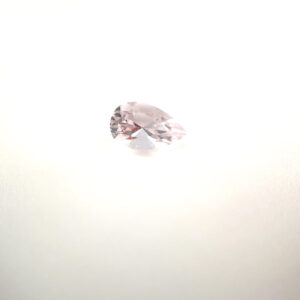
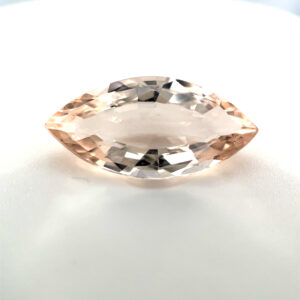
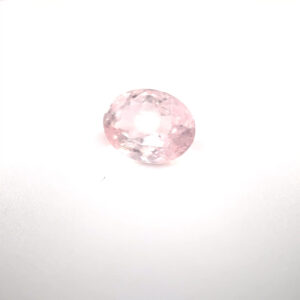
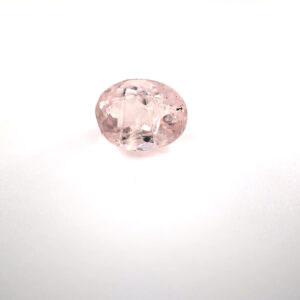

GEM INFORMATION
FEATURES
| MINERAL | Beryl |
| CHEMICAL MARK | Be₃Al₂Si₆O₁₈- Beryllium aluminum silicate |
| COLOR | Pink/ Orange-pink / Pink-purple / Yellow-orange |
| REFRACTION INDEX | 1.583 – 1.590 |
| BIREFRINGENCE | 0,007 – 0,008 |
| HARDNESS ACCORDING TO THE MOHS CHART | 7,5- 8,00 |
| SPECIFIC WEIGHT | 2,67- 2,90 |
WHY WILL HE GET YOU?
Morganite can win you over with what its color and softness provide to our senses, or with what historical data about it provides us.
This pink-orange delicate gemstone was dedicated to Ashtar - the goddess Ishtar - the Phoenician goddess of love, fertility and war, whose cult gradually spread to the surrounding countries, where in the environment of ancient states it gradually merged with the Greek Aphrodite or the Roman Venus, goddesses of beauty, love, sexuality and fertility. Ishtar corresponds to the classical dualistic understanding, in which she represents the feminine face of the world, embodying both positive and negative female qualities. Two sides of the same coin, summer and winter. She was most often depicted with horns (a symbol of fertility), between which the sun figured, with a crescent moon, a magic belt, a dove and a lion.
The ancient Romans believed that beryl crystals had aphrodisiac properties, allowing their owner to experience intoxicating sexual desires and arouse romantic feelings.
Morganite seems to be attuned to the frequency of love – not just for a partner, but for self-love as well. It can help us be kind to ourselves and see the beauty in sensitivity. It reminds us that we deserve not only to love, but also to be loved.
It is the personal stone of people born under the sign of Libra and therefore born at the end of September or in October.
CHARACTERISTICS
Morganite is a pink variety of the mineral beryl, which also includes well-known gemstones such as emerald and aquamarine. Its typical color is due to the presence of manganese and varies from soft pink to peach or salmon. In nature, it occurs in the form of well-developed crystals, most often in pegmatites, which are coarse-grained igneous rocks rich in minerals.
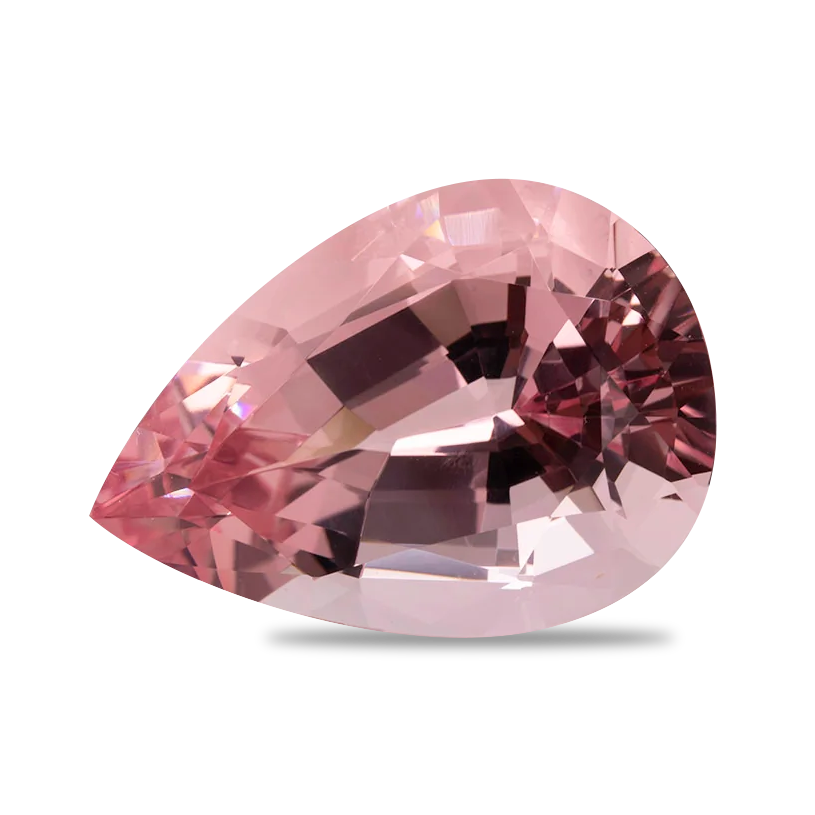
This semi-precious stone has a delicate, elegant appearance and often appears clean and clear. It is transparent to translucent and has a vitreous luster that makes it attractive for cutting into jewelry. It is a relatively hard mineral - it reaches a value of 7.5 to 8 on the Mohs hardness scale, which means it is scratch-resistant and suitable for everyday wear.
Its crystals belong to the hexagonal system. Morganite is usually found in a relatively pure state - without inclusions visible to the naked eye. It has weak pleochroism, which means that it can change shades of pink when viewed from different angles.
When caring for morganite, it is recommended to avoid sharp impacts because, despite its hardness, it can crack. For cleaning, mild warm water with soap and a soft brush are sufficient.
WHAT IS THE MAGIC?
The charm of Morganite lies in its subtle elegance, femininity and ability to look impressive in jewelry. Its pink-peach shades are discreet, yet irresistible. The sight of it caresses the soul. It is like a whisper among gems, a silent power, vulnerability and at the same time indomitability. Despite being a modern discovery, its energy is timeless.
Jewelry made of it becomes a personal expression of taste, delicacy and elegance. It is becoming increasingly popular due to its soft color symbolizing tender, patient love. It is most often combined with rose or white gold, which further emphasizes its romantic character.
VALUE
Morganite has seen a surge in demand in recent years, particularly due to its use in engagement rings. It is a popular and less expensive alternative to pink diamonds or pink sapphires.
Morganite is valued primarily for its color. Deep pink to pinkish-purple is the most valuable. Peach or salmon color tends to be a bit less expensive but is still highly sought after. Pale pink and almost translucent pieces are of lower value.
In terms of clarity, morganites are mostly very clean. With no or minimal inclusions visible to the naked eye. Stones with visible flaws are less expensive.
In terms of cut, a well-cut stone reflects light evenly, thus increasing its visual appeal. It can have a classic round, oval, emerald, cushion, or fancy cut.
Price and value also increase with weight, but not linearly – larger quality pieces are significantly more expensive. Morganite is relatively common in larger pieces, so 5+ carat stones are not as rare as diamonds.
Most morganites are heat treated to remove yellow tones and enhance color. Untreated pieces have a higher collector's value, but this is not always essential in jewelry.
COLOR
Its primary color is pink. However, it occurs in various variations from beautifully transparent stones to opaque ones, through silvery pink, peach to light blue or purple. Its coloring is caused by trace elements of manganese and a distinctive optical phenomenon called plechoroism. Thanks to it, the gemstone exhibits a different shade, or saturation of color. The distinctive color of morganite is truly rare and the stones must be relatively large to achieve their best color.
ORIGIN
It is a rare semi-precious stone found only in Thailand, Brazil, Madagascar, Africa, and the United States.
Morganit sa ťaží v pegmatitoch, čo sú hrubozrnné vyvreté horniny bohaté na minerály ako beryl, turmalín, kremeň atď. Vzniká počas neskorších štádií kryštalizácie magmy, keď je v hornine vysoký obsah vody a vzácnych prvkov (lítium, cézium, berýlium).
The first known findings of Morganite come from Madagascar (this is where the pure pink crystals come from.), specifically from the area Anjanabonina (Antananarivo region), at the beginning of the 20th century, approximately in 1902. At that time it was discovered that it was a pink variety of beryl, which had not been classified as a separate gemstone until then. His research was devoted to George Frederick Kunz – a prominent American gemologist and mineralogist who worked for the company Tiffany & Co. and was also a consultant to the Smithsonian Institution. He was one of the most influential gemologists in the United States at the turn of the 19th and 20th centuries. He had a passion for the systematic collection, description, and popularization of gemstones. In 1910 Kunz navrhol, aby nový ružový variant berylu, objavený na Madagaskare, bol pomenovaný na počesť J.P. Morgana – an American banker and prominent mineral collector.
Other important sites:
USA:
–California – known finds in the area Pala– historické bane, kde bol objavený „Ružový beryl“. Tiež známy nález v bani Thomas Mine in the year 1911.
–Maine – known pegmatite mines, sometimes together with tourmaline.
Brazil – over time, it became one of the main exporters, from where larger crystals with a peach hue are often brought to light.
Afghanistan (Nuristan) – high-quality, richly colored pieces.
Namibia – mainly smaller, but high-quality crystals.
Pakistan, Russia – although they are less well known, morganite deposits are also found here


